You have a limited marketing budget and a choice to make. Do you put everything into Instagram and Facebook, or do you also invest in Google search, SEO, email and a better website? Many business owners treat this as a contest between two options, and that is where the confusion starts.
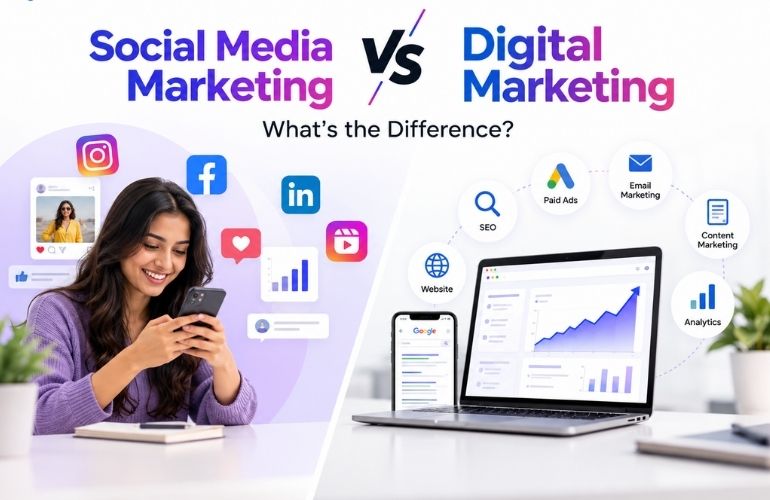
The short answer: social media marketing is a subset of digital marketing, not a rival to it. Digital marketing is the full set of online channels you can use to reach customers, and social media is one of them. This guide explains the difference between social media marketing and digital marketing, how they work together, and where to start.
What Is Digital Marketing?
Digital marketing is any marketing that uses online channels to reach, convince and retain customers. It is an umbrella term. Under it sit search engine optimisation (SEO), search advertising, social media, email and WhatsApp communication, content marketing, website and landing page optimisation, influencer collaborations, and the analytics that tie these together.
What unites these channels is that they are measurable and can be linked to a business goal such as enquiries, bookings or online orders. If you are weighing organic search against paid search, our comparison of SEO vs Google Ads shows how those two channels behave differently.
Example: A dental clinic in Indore appears on Google Maps when people search "root canal near me", runs a few Google ads for aligners, posts patient education videos on Instagram, and sends appointment reminders by email or WhatsApp. Each of those is a digital marketing activity. Together they cover discovery, trust and repeat visits.
What Is Social Media Marketing (SMM)?
Social media marketing means using social platforms such as Instagram, Facebook, LinkedIn and YouTube to build awareness, start conversations and bring people towards your business. It includes planning content, publishing posts, reels and stories, replying to comments and messages, and building a community around your brand.
It works in two ways:
- Organic social: unpaid posts, videos and engagement from your own profiles.
- Paid social: ads shown to selected audiences on the same platforms.
Social media advertising is therefore one part of social media marketing, not a synonym for it. A business can post consistently without spending on ads, and a business can run ads with very little organic activity. Most effective programmes use both, with organic content building familiarity and ads reaching people who do not yet follow you.
Platform choice matters too. LinkedIn suits B2B relationships, Instagram suits visual products and services, and YouTube suits explanation-heavy buying decisions.
Social Media Marketing vs Digital Marketing: Key Differences
The two are not separate disciplines at the same level. Digital marketing is the whole; social media marketing is one section of it. The practical differences come down to scope, intent and measurement.
- Scope: Social media marketing covers one channel group — social platforms. Digital marketing covers all online channels combined.
- Typical channels: Social media marketing uses Instagram, Facebook, LinkedIn, YouTube, and X. Digital marketing includes SEO, search ads, social, email, content, website, and WhatsApp.
- Common goals: Social media marketing focuses on awareness, engagement, community, and leads. Digital marketing spans from awareness through to leads, sales, and retention.
- Audience intent: Social media is often discovery — people are browsing, not searching. Digital marketing includes high-intent search as well as discovery.
- Content formats: Social media uses posts, reels, stories, live videos, and carousels. Digital marketing also includes blogs, landing pages, emails, videos, and tools.
- Measurement: Social media measures reach, engagement, follower growth, and social leads. Digital marketing measures traffic, conversions, cost per lead, revenue, and retention.
- Asset ownership: Social media audiences sit on rented platforms. Digital marketing includes owned assets such as your website, email list, and content.
- Best suited to: Social media marketing suits brand visibility and relationship building. Digital marketing suits a complete growth plan across the customer journey.
Do not read this as "social is for awareness, digital is for sales." Social media can generate leads directly, and a digital marketing plan can include pure brand-building work.
How Social Media Marketing Fits into a Digital Marketing Strategy
Social media is usually the start of a journey, not the whole of it. Here is how it connects to the rest.
Consider an interior design studio. A reel showing a before-and-after kitchen makeover reaches homeowners on Instagram. A viewer taps through to a landing page with a short portfolio and an enquiry form. Because the page has tracking set up, the studio sees which post produced the enquiry. The lead goes into a CRM, gets a call and a WhatsApp follow-up, and, if they do not book, is shown remarketing ads over the next few weeks.
In this chain, social media creates attention, but the website, tracking, follow-up and remarketing turn that attention into revenue. A weak link anywhere reduces the return. This is why a well-built page matters as much as the post, and why website design for business growth belongs in any social media plan.
Which Delivers Better Results: Social Media Marketing or Digital Marketing?
This is not a like-for-like comparison. Because social media marketing sits inside digital marketing, the better question is which channels deserve your budget for the goal you have right now. No channel offers guaranteed leads or instant returns, and results depend on the offer, audience, competition and execution.
Match the channel to the objective:
- Awareness: Social media, video and display ads work well because they put you in front of people who were not searching.
- Search-demand capture: SEO and search ads reach people already looking for what you sell.
- Leads and sales: A combination of landing pages, ads, email and sales follow-up usually matters more than any single channel.
- Retention: Email, WhatsApp and community content keep existing customers engaged.
Choose measures that fit the goal. Reach and engagement tell you whether social content is being noticed. Qualified leads, cost per acquisition (CAC) and conversion rate tell you whether marketing is producing business. For ecommerce, revenue and return on ad spend (ROAS) add the financial view. Followers and likes alone rarely answer a commercial question.
What Should Small Businesses Choose?
Small businesses should choose by customer behaviour, budget, buying intent and what they can measure. A few typical scenarios show how.
A New Local Business
Start with the basics that make you findable: a Google Business Profile, a simple website, and an active Instagram or Facebook page with real photos and reviews. Social media builds familiarity in your neighbourhood while local search captures people ready to visit. Our local digital marketing guide covers this mix in more detail.
A B2B Service Provider
Buyers research before they contact anyone, so search visibility, case-style content and a clear website carry most of the weight. LinkedIn is useful for authority and outreach, but it rarely works well without a site that explains your services.
An Ecommerce Brand
Social platforms drive discovery for visual products, while search and email capture repeat demand. Paid social is often central, so understanding Meta Ads audience types helps you target without wasting money.
A Limited-Budget Business
Do not spread thin. Pick one discovery channel and one conversion path, such as Instagram plus a WhatsApp enquiry button, and measure it for a few months before adding more.
A simple three-step checklist:
- Identify where your customers look when they decide to buy: search, social, referrals or marketplaces.
- Fund one primary channel and one conversion asset (website or landing page) before anything else.
- Track enquiries and sales, not just activity, then expand to the next channel.
Common Mistakes When Comparing SMM and Digital Marketing
- Treating followers as revenue. A large audience that never enquires is a vanity metric, not a result.
- Running ads without a landing page. Sending traffic to a profile or a slow, unclear page wastes budget.
- Believing every channel is mandatory. You need the channels your customers use, not all of them.
- Not tracking conversions. Without form, call and WhatsApp tracking, you cannot tell what works.
- Confusing organic posting with advertising. Posting regularly does not replace paid reach, and ads do not replace consistent content.
Avoiding these mistakes usually improves results more than adding a new platform.
How Infozy Media Can Help Build the Right Marketing Mix
Infozy Media Pvt. Ltd. is a digital marketing and website development agency in Indore. We work with businesses to decide which channels fit their goals and budget, then build and manage them together rather than as isolated tasks. That can include social media marketing, search and paid campaigns, content, and the website that receives the traffic.
If you are unsure where to begin, book a consultation with our team. We will look at your current setup and suggest a practical starting point.
Final Thoughts
Social media marketing vs digital marketing is not an either-or decision. Social media marketing is a part of digital marketing, and its value depends on how well it connects to your website, tracking and follow-up.
For most small businesses, the sensible path is to start with the channel where your customers already are, make sure there is a clear page to send them to, and measure real enquiries. Add search, email or other channels once the first one is working. A focused mix will usually serve you better than being everywhere at once.
Frequently Asked Questions
Que.1 Is social media marketing part of digital marketing?
Ans. Yes. Digital marketing covers all online channels, including SEO, search ads, email and content. Social media marketing is the part that uses social platforms such as Instagram, Facebook and LinkedIn to reach and engage customers.
Que.2 Is digital marketing better than social media marketing?
Ans. They are not directly comparable, since one includes the other. Digital marketing offers a wider mix of channels, while social media marketing is one useful channel. The right choice depends on your goals, audience and budget.
Que.3 Can social media marketing generate leads without SEO?
Ans. Yes, through enquiry forms, direct messages, WhatsApp clicks and paid social ads. Results vary by industry and offer. SEO adds a separate source of leads from people searching on Google, so many businesses eventually use both.
Que.4 Which is more affordable for a small business?
Ans. Starting with one social channel is often cheaper than a multi-channel plan, but costs depend on content quality, ad spend and who manages it. Compare cost per enquiry rather than monthly price alone.
Que.5 Do I need both SEO and social media marketing?
Ans. Not always at the start. SEO captures people actively searching, while social media builds awareness and trust. Many businesses begin with whichever matches how their customers buy, then add the other as budget and tracking allow.
Que.6 What is the difference between SMM and social media advertising?
Ans. SMM covers all social activity, including organic posts, community management and ads. Social media advertising refers only to paid campaigns on those platforms. Advertising is one part of SMM, not the whole.