You're running ads. You're posting on social media. You're putting effort and budget into SEO. But enquiries still aren't matching the traffic. If this sounds familiar, the problem may not be your marketing at all — it may be the website your marketing is sending people to.
A business website that once worked perfectly well can quietly turn into a growth barrier. It stops representing what the company has become, stops working the way visitors expect, and stops converting the traffic everyone worked so hard to bring in. In short: if your website can't keep up with your customers or your marketing, it's time to consider a new one.
What Does Website Design Have to Do With Business Growth?
Website design isn't just about how a site looks. A well-designed website is a working system — one that carries a visitor through a journey: Attract → Inform → Build Trust → Convert → Grow.
That journey depends on several things working together:
- User experience — how easily someone finds what they came for
- Navigation — whether the site structure makes sense or feels like a maze
- Mobile responsiveness — since most visitors are browsing on a phone
- Content structure — how clearly services, pricing, and information are presented
- Conversion paths — forms, calls-to-action, and next steps that are easy to act on
- Trust signals — testimonials, certifications, case studies, clear business information
- Performance — load speed and technical reliability
- SEO foundations — structure that search engines can actually understand
- Brand positioning — whether the site reflects who the business is today
When these elements work together, a website supports growth. When even a few of them break down, the whole journey suffers — no matter how much traffic you're driving to it.
Why an Outdated Website Can Hold Your Business Back
The pattern is simple, and most business owners have seen some version of it: a poor website experience leads to lost attention, which leads to lower engagement, which leads to fewer enquiries, and eventually to missed business opportunities.
An outdated website affects more than aesthetics. It affects:
- Credibility — visitors judge a business's professionalism within seconds of landing on the site
- Customer experience — confusing layouts push people to leave rather than explore
- Search visibility — outdated structure and technology often work against SEO
- Conversions — even good traffic won't convert on a site that doesn't guide visitors clearly
- Competitive standing — if a competitor's site is easier to use, that's often where the enquiry goes
- Marketing ROI — every rupee spent on ads or content is only as effective as the website receiving that traffic
This is the underlying issue behind most of the nine signs below — a website that no longer supports the business built around it.
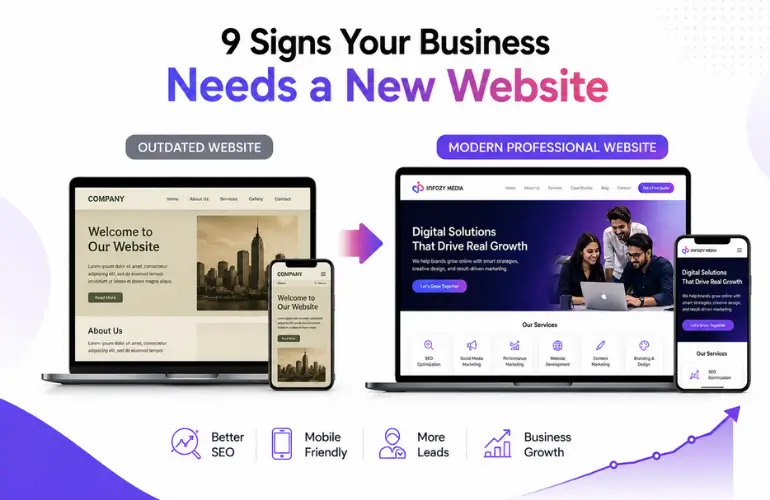
9 Signs Your Business Needs a New Website
1. Your Website Looks Outdated
Design trends move fast, and a site built even five or six years ago can look noticeably dated — old-style layouts, low-resolution images, cluttered typography, or a visual identity that doesn't match how the business presents itself today. This matters because visitors form a credibility judgment almost immediately. A business offering premium services with a dated, unpolished website creates a mismatch that's hard to overcome, no matter how good the actual service is. Working with an experienced website designer in Indore can help realign the visual identity with where the business actually stands today.
2. Your Website Isn't Mobile-Friendly
A large share of business website traffic now comes from phones. If your site wasn't built mobile-first, visitors are likely dealing with text that's too small, buttons that are hard to tap, menus that don't collapse properly, or forms that are frustrating to fill out on a small screen. When mobile usability breaks down, people don't struggle through it — they leave. And Google factors mobile experience into how it ranks pages, so this issue compounds into an SEO problem as well.
3. Your Website Is Slow or Difficult to Use
Speed and usability are functional issues, not cosmetic ones. Slow-loading pages, broken links, outdated plugins, or a clunky backend all chip away at visitor patience — and at your search rankings. If your team also finds the website difficult to manage internally, that's usually a sign the underlying technology has fallen behind what modern website development services can offer.
4. Visitors Aren't Turning Into Leads or Customers
This is one of the clearest signs of all: traffic is coming in, but enquiries aren't. Often the cause is unclear calls-to-action, confusing navigation that buries contact information, weak or overly long forms, or a customer journey that doesn't lead anywhere specific. Traffic is only valuable when the site is built to convert it — otherwise, marketing spend is generating visits without generating business.
5. Your Website No Longer Reflects Your Business
Businesses evolve — new services get added, new locations open, target customers shift, and positioning changes. But websites often don't get updated to match. If your site still talks about services you've phased out, misses ones you now offer, or speaks to an audience you've since outgrown, it's actively working against your current business goals rather than supporting them.
6. Your Website Is Holding Back Your SEO
Search engines rely on clear structure, clean code, fast performance, and organized content to understand and rank a website. An outdated site with confusing navigation, poor internal linking, and slow load times gives search engines less to work with — and gives competitors with better-structured sites an easier path to rank ahead of you. Strong website development is often the foundation SEO efforts need before they can really take effect.
7. Your Competitors Offer a Better Online Experience
This isn't just about which site looks nicer. It's about which one is easier to navigate, presents services more clearly, loads faster, shows stronger trust signals, and makes the next step obvious. If a prospective customer is comparing two businesses side by side and one website makes the decision easier, that's usually where the enquiry goes — regardless of which business is actually the better fit.
8. Your Website Is Difficult to Update or Scale
Some websites are built on outdated CMS platforms or custom code that makes even small changes — a new page, a pricing update, a blog post — dependent on a developer and slow to execute. As marketing needs grow (landing pages for campaigns, new service pages, integrations with CRM or analytics tools), a website that can't scale becomes a bottleneck rather than an asset.
9. Your Website Doesn't Support Your Marketing Strategy
A website isn't separate from your SEO, Google Ads, Meta Ads, social media, and content marketing — it's where all of that traffic ultimately lands. If the site isn't built to convert, every other marketing channel underperforms as a result. Poor landing pages, missing tracking and analytics, and disconnected user journeys all quietly reduce marketing ROI, even when the campaigns themselves are well-executed.
Should You Redesign Your Website or Build a New One?
Not every one of these signs means you need to start from scratch. Sometimes a redesign is enough; other times, a rebuild is the more practical option.
A redesign is often sufficient when:
- The core technical foundation is solid, but the visual design feels dated
- The site structure mostly works, but navigation and content need reorganizing
- The CMS is capable, but content and UX need updating
- Performance issues are minor and fixable
A new website is usually the better route when:
- The business has changed significantly since the site was built
- The CMS is outdated, limited, or difficult to scale
- Core UX problems run deep — confusing structure, poor mobile experience, weak conversion paths
- Performance and technical issues are extensive rather than isolated
A business doesn't automatically need a new website just because the current one is old. The real question is whether the existing site can still support the business's goals, customers, marketing, technology, and growth plans. If it can, a redesign may solve the problem. If it can't, rebuilding gives you a stronger foundation to grow on.
How Better Website Design Can Support Business Growth
- Better User Experience: A site that's easy to navigate keeps visitors engaged longer and reduces the friction between interest and action.
- More Conversion Opportunities: Clear CTAs, well-placed forms, and a logical journey turn more of your existing traffic into actual enquiries.
- Stronger SEO Foundation: Clean structure, fast performance, and mobile usability give search engines what they need to rank your pages effectively.
- Greater Brand Credibility: A modern, professional website reassures visitors that they're dealing with a business that takes itself — and its customers — seriously.
- Better Marketing Performance: When the website converts well, every other channel — SEO, paid ads, social media, content — gets more value out of the traffic it generates.
Website design works best when it's treated as part of the broader digital marketing ecosystem, not a standalone project that's finished once the site goes live.
Who Can Benefit From a Website Redesign?
Service Businesses
For service-based businesses, the website is often the first real impression a prospective client gets. Clear service explanations, visible trust signals, and simple enquiry paths directly affect lead volume.
E-commerce Businesses
Product discovery, mobile shopping experience, and a smooth checkout process all directly influence conversion rates and cart abandonment.
Healthcare and Clinics
Patients look for credibility, clear service information, and easy ways to book appointments or ask questions — a confusing site can cost real patient trust.
Real Estate Businesses
Strong property presentation, clear location details, and simple enquiry forms make the difference between a browser and a serious lead.
B2B and Manufacturing Companies
These businesses rely on the website to establish credibility, explain technical products or services clearly, and generate qualified enquiries from decision-makers.
Startups and Growing Businesses
As positioning and offerings evolve quickly, a scalable website that can grow alongside marketing efforts becomes essential rather than optional.
What to Look for in a Website Development Company
Choosing the right partner matters as much as the redesign itself. A capable website development company in Indore should be able to demonstrate:
- A clear understanding of your business goals, not just design preferences
- UX-focused design decisions backed by reasoning, not just visual trends
- SEO-friendly development practices from the ground up
- Genuinely responsive design tested across devices
- Scalable technology that can grow with the business
- Conversion-focused structure, not just attractive layouts
- Proper analytics and tracking setup
- Support for integrations your business actually needs
- Reliable post-launch support
- An understanding of how the website fits into digital marketing, not just how it looks on launch day
When businesses search for a top website development company, what they're usually really looking for is a partner who understands all of the above — not just a design vendor.
Why Choose Infozy Media for Website Design and Development?
Infozy Media approaches website design and development as part of a connected digital marketing strategy, not an isolated project. Since a website's real job is to support SEO, generate leads, and convert traffic from paid and organic channels, our approach to website development services factors in SEO-friendly structure, conversion-focused UX, content, and analytics from the planning stage — not as an afterthought.
Our capabilities include website design, website development, website redesign, SEO-friendly website architecture, conversion-focused UX, landing page development, and ongoing digital marketing support once the site is live. As a web design company in India working closely with SEO, paid advertising, and content teams under one roof, we build websites with the next stage of marketing already in mind.
Is Your Website Helping Your Business Grow?
If your website shows even a few of the signs above, it's worth stepping back and honestly evaluating whether it's still doing its job — supporting your marketing, representing your business accurately, and converting the visitors you're working hard to attract.
A website that once served the business well can still hold it back today if it hasn't kept pace with growth. The businesses that treat their website as an active growth tool, rather than something built once and left alone, are usually the ones getting more out of every other marketing effort.
If you're unsure where your website currently stands, Infozy Media can walk through a website evaluation with you and help you decide whether a redesign or a new website makes more sense for where your business is headed.
Frequently Asked Questions About Website Design and Redesign
Que.1 How do I know if my business needs a new website?
Ans. Look for signs like outdated design, poor mobile experience, slow loading, low conversions despite steady traffic, and a website that no longer reflects your current services or positioning. If several of these apply, it's worth a professional evaluation.
Que.2 How often should a business redesign its website?
Ans. There's no fixed timeline, but many businesses find a review every 2–3 years useful, especially as design standards, technology, and business needs evolve. The right timing depends more on performance and business changes than on a set schedule.
Que.3 Can a new website help my business grow?
Ans. Yes — when it improves user experience, conversion paths, and SEO foundations, a new website can turn more existing traffic into actual leads and support stronger performance across your other marketing channels.
Que.4 Does website design affect SEO?
Ans. Yes. Site structure, mobile usability, page speed, and navigation all influence how well search engines can crawl, understand, and rank your website.
Que.5 Can website redesign improve SEO?
Ans. It can, when the redesign addresses technical and structural issues — such as slow performance, poor mobile usability, or unclear content organization — that were previously limiting search visibility.
Que.6 Should I redesign my website or build a new one?
Ans. It depends on your current technical foundation. If the core structure is solid and only the design or content needs updating, a redesign usually works. If the CMS, UX, or performance issues run deeper, a new website is often the more practical long-term option.
Que.7 How do I choose a website development company in Indore?
Ans. Look for a team that understands your business goals, builds SEO-friendly and conversion-focused websites, offers scalable technology, and understands how the website connects to your wider digital marketing strategy — not just a vendor focused on visual design alone.
Que.8 How much does website development cost in India?
Ans. Costs vary based on factors like the number of pages, design complexity, CMS platform, required functionality, integrations, e-commerce needs, content requirements, and ongoing support. It's best to discuss your specific requirements to get an accurate estimate.