 Google Ads
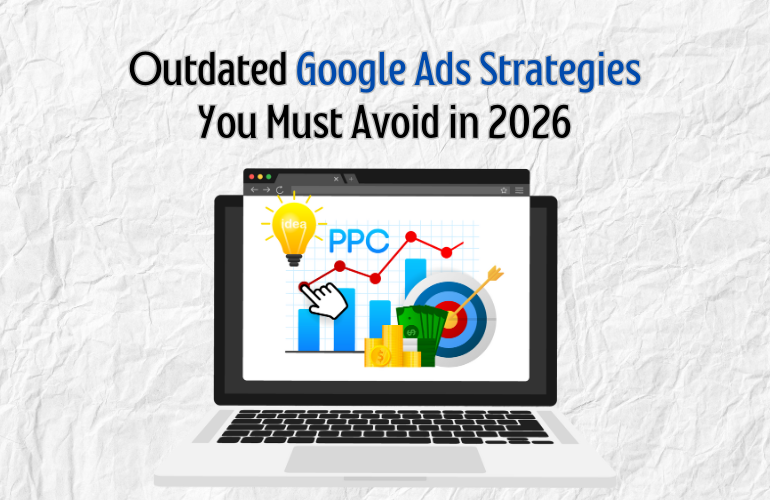
The Google Ads Strategies Holding Your Campaign Back in 2026
The world of digital advertising, especially Google Ads, has evolved at lightning speed. Strategies that were once powerhouses are now outdated and actively hindering your campaign success, particularly when targeting the dynamic market of India. If you're relying on old habits, your ads are fighting against Google's sophisticated machine learning (ML) capabilities.
Here are the critical, outdated Google Ads strategies you must stop using in 2026, and how to pivot to a modern, conversion-focused approach.
1. Heavy Reliance on Phrase Match: The Control Trap in India's Search Landscape
For years, the conventional wisdom was to avoid Broad Match keywords due to concerns about irrelevant search queries, low Click-Through Rates (CTR), and wasted spend. Phrase Match was the perceived "sweet spot" that offered control without being overly restrictive like Exact Match.
Why it No Longer Works:
Google's ML is drastically better at understanding intent and relevance. The core goal of modern Google Ads is to leverage automation. By exclusively using Phrase Match, you restrict the system's ability to explore valuable, related search terms that could drive high-quality conversions. You're sacrificing potential high-value traffic for a false sense of control.
The Infozy Media Solution for the Indian Market:
Embrace Broad Match with Smart Bidding: Start with your most successful core keywords in Broad Match and pair them immediately with Automated Bidding Strategies (like Maximize Conversions or Target CPA). This allows Google's system to bid aggressively only when the auction signals high conversion potential, mitigating the risk of irrelevant clicks.
Constant Negative Keyword Management: The control you seek isn't in the match type; it's in consistently monitoring the Search Term Report and adding irrelevant terms as negative keywords. This is the only way to clean up Broad Match traffic and ensure high-quality signals for the machine.
Theme Your Ad Groups: Ensure each Ad Group is tightly themed, and its ads and landing pages are highly relevant to those few core keywords. This is the simple rule for Ad Group success.
2. Manual CPC Bidding: You Can't Outsmart the Algorithm
Manual CPC was a favorite for brands with a small number of high-volume keywords and limited budgets. It allowed advertisers to dictate the maximum bid for every auction, providing a feeling of absolute control over cost.
Why it No Longer Works:
A human bidder simply cannot process the thousands of real-time auction signals (user location, device, time of day, historical performance, conversion value, etc.) that Google's algorithm processes in milliseconds. By setting a rigid manual bid cap (e.g., ₹10), you actively prevent the system from bidding slightly higher in a high-value auction that would have certainly resulted in a sale. This dramatically slows down the machine's learning and optimization capabilities.
How Infozy Media Optimizes Bidding for India Campaigns:
Switch to Smart Bidding Immediately: Implement Smart Bidding strategies. You can start with Maximize Clicks with an Upper Limit to maintain some control over cost, but the goal should be to quickly transition to Conversion-Based Automated Strategies (Max Convert Value, Target ROAS, Target CPA) once you have conversion data.
Focus on Conversion Quality: Continuously test the quality of leads generated from different bidding strategies. The goal is to maximize Lead Quality and Value Signals, not just clicks or impressions. Our experts ensure your campaign's primary goal aligns with true business value.
3. Over-Pinning in Responsive Search Ads (RSAs): Choking Off Performance
Responsive Search Ads (RSAs) are the default search ad format today. They allow you to provide multiple headlines and descriptions, which Google then mixes and matches to find the best-performing combination for a specific user query. Over-pinning is when an advertiser forces certain headlines or descriptions into specific positions.
Why it No Longer Works:
Over-pinning severely limits Google's ability to test and optimize permutations and combinations. By restricting the system, you lower your Ad Strength and potential Quality Score, which is crucial for winning auctions. Google is now highly capable of dynamically serving the most relevant combination based on user intent. When you apply too many restrictions, Google may not even send your ad to the auction, resulting in poor impression share and budget under-spending.
Infozy Media's Modern Ad Copy Approach:
Design for Flexibility: Craft headlines and descriptions that are all relevant and can work in any combination. You should only consider pinning legally required text or a Brand Name.
Allow ML to Test: Give the system the freedom to learn which combinations drive the highest performance for different user segments. Our copywriters ensure the variety is broad enough for effective testing while maintaining message consistency.
4. Splitting Budget Across Too Many Campaigns: Diluting Your Learning Signals
A common mistake is taking a modest budget (e.g., ₹1,000 per day) and splitting it across 3–4 different campaigns.
Why it No Longer Works:
Google's AI needs Budget Density combined with Signal Density to learn effectively. Splitting your budget and conversion signals across multiple campaigns actively delays learning and chokes the Smart Bidding algorithms. For optimal performance, a single campaign should ideally achieve 10–15 conversions per week. Splitting the budget makes this difficult, resulting in slow optimization and poor scale.
Our Consolidation Strategy for Maximum Impact:
One Campaign Per Business Goal: Merge smaller, related campaigns into one robust campaign. Focus your budget to achieve the minimum recommended daily spend of approximately ₹3,000 (or more) to give Smart Bidding the necessary fuel for learning.
Use Data-Driven Attribution (DDA): Stop using the outdated Last Click Attribution. DDA uses advanced algorithms to credit the conversion value to all touchpoints in the user's journey (full-funnel), giving you a more accurate view of which campaigns are truly contributing to your success.
Partner with Infozy Media to Scale Your India Success
If you recognize any of these outdated tactics in your current Google Ads setup, it's time for a professional audit and overhaul. Infozy Media specializes in re-engineering Google Ads accounts to leverage the power of automation and machine learning, ensuring your campaigns are built for 2026 and beyond. We focus on integrating sophisticated bidding, creative variety, and consolidated signal architecture to maximize your conversion volume and quality in the competitive Indian market.
Contact Us
Schedule a free consultation today to discuss your campaign goals and explore a tailored Google Ads strategy.
Infozy Media Private Limited
Call Now: 1800-572-2272
Email Us: info@infozy.in
Visit Us: 202 B, Princes' Business Skyline, AB Rd, Vijay Nagar, Indore, Madhya Pradesh 452001
00 Comments
Leave a Comment
Your email address will not be published. Required fields are marked *