AI has moved from being an experimental technology to a practical part of everyday digital marketing. It can help create content, analyze campaign data, identify audience patterns, personalize messages and automate repetitive work.
That change has created a bigger question for businesses: if AI can handle so many marketing tasks, do companies still need human marketers or a digital marketing agency?
The answer depends on what we mean by "replace." AI can already perform some tasks faster than people. It can also make recommendations and, in certain advertising systems, automatically optimize campaigns against predefined goals. But a complete marketing strategy involves much more than executing individual tasks.
The real shift is not simply from humans to AI. It is from manual marketing workflows toward AI-assisted marketing, where technology handles more operational work while people focus on strategy, context, creativity and business decisions.
What Can AI Actually Do in Digital Marketing?
The role of AI in digital marketing is expanding because modern AI systems can process large amounts of information quickly and recognize patterns that would take humans much longer to analyze.
Businesses and marketing teams can use AI for tasks such as:
- Content assistance: Creating first drafts of captions, ad copy, product descriptions and content outlines.
- Audience analysis: Finding patterns in customer behavior, engagement and purchase data.
- Personalization: Adjusting messages and recommendations according to customer behavior.
- Campaign analysis: Identifying trends across large amounts of performance data.
- Automation: Supporting email workflows, reporting, scheduling and other repetitive processes.
- Creative testing: Producing multiple variations of headlines, messages and creative concepts for testing.
- Predictive analysis: Using historical data to identify patterns that may help with future campaign decisions.
- Optimization: Helping advertising systems adjust bids, targeting or delivery based on defined objectives.
This is where AI driven digital marketing can make a practical difference. Instead of spending hours collecting data or preparing repetitive reports, marketers can use that time to analyze what the information means and decide what should happen next.
The important distinction is that automating an activity is not the same as owning the strategy behind it.
The Role of AI in Digital Marketing Is Changing the Workflow
The role of AI in digital marketing is easier to understand when you compare a traditional workflow with an AI-assisted one.
A conventional process might look like:
- Collect data → analyze results → identify problems → adjust campaign → measure again
With AI assistance, some of that process can become:
- Collect data → AI analyzes patterns → recommendations or automated optimization → human review → further action
In some platforms, the human does not manually make every operational adjustment. For example, automated advertising systems can use machine learning to optimize bids and delivery according to selected campaign goals.
That does not mean the system understands the entire business.
A campaign can achieve a lower cost per click while attracting the wrong audience. It can generate more leads while producing fewer qualified prospects. It can improve engagement without increasing sales.
AI can process the signals. Someone still needs to determine whether those signals represent meaningful business progress.
That is one of the biggest changes AI is bringing to marketing: less time spent on manual execution and more importance placed on deciding what should be measured, why it matters and what action should follow.
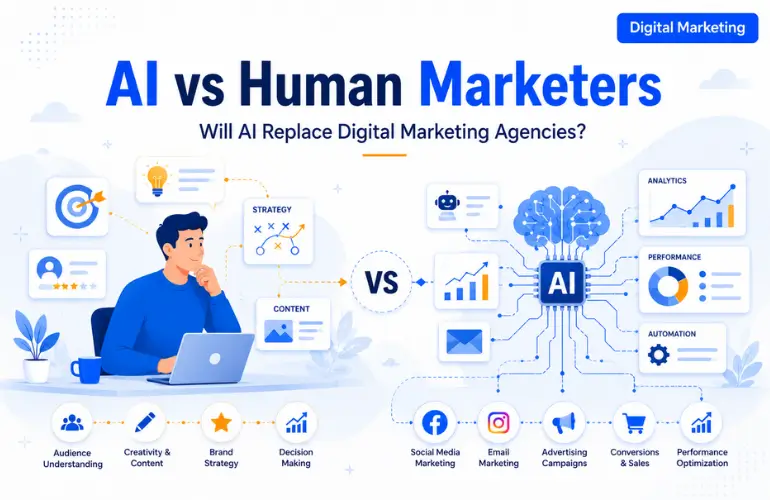
AI vs Human Marketers: Where Each One Has an Advantage
The debate becomes clearer when AI and human marketers are compared by the type of work they perform.
- Data analysis: AI processes large datasets quickly — humans interpret results in business context.
- Repetitive work: AI automates routine tasks — humans decide which tasks should be automated.
- Content: AI creates drafts and variations — humans develop the final message and brand voice.
- Personalization: AI uses customer data at scale — humans decide what is genuinely relevant.
- Campaign optimization: AI finds patterns and adjusts predefined variables — humans decide whether the optimization supports business goals.
- Creativity: AI generates multiple ideas and variations — humans select, develop and challenge ideas.
- Brand strategy: AI identifies patterns in existing information — humans define positioning and long-term direction.
- Customer understanding: AI analyzes behavioral signals — humans understand motivations and real-world context.
- Crisis management: AI can detect unusual activity or sentiment changes — humans decide how the brand should respond.
- Business decisions: AI provides data and recommendations — humans weigh risk, priorities and commercial impact.
This does not mean AI is limited to simple automation. Its capabilities are becoming more sophisticated. The important point is that marketing decisions exist within a business context that cannot always be reduced to historical data or predefined objectives.
A marketer may know that a particular campaign is technically performing well but still recommend changing it because the product positioning has shifted, a competitor has entered the market or the business is targeting a different customer segment. That context can change the correct decision.
Can AI Replace a Digital Marketing Agency?
AI can replace or reduce the need for some individual marketing tasks. That is already happening. But an agency is not simply a collection of tasks.
A business working with an agency may need help with:
- Market and audience research
- Brand positioning
- Campaign strategy
- Search engine optimization
- Social media
- Content
- Paid advertising
- Email campaigns
- Analytics
- Conversion optimization
- Performance reporting
- Ongoing campaign improvements
These activities are connected. For example, changing the target audience can affect the advertising message. That message can affect the landing page. The landing page can affect conversion rates. Those conversions can influence advertising decisions and future content.
AI can assist at several points in this process. It does not automatically determine the best overall strategy for every business.
This is why the future of digital marketing services is likely to involve greater use of AI rather than simply removing people from the process.
The more useful question for a business is not: "Does this agency use AI?" It is: "Does this agency use AI in a way that improves the decisions and results that matter to my business?"
How AI Is Changing SMM Marketing
Social media is one of the areas where AI can save significant amounts of time. For teams working on social media marketing, AI can support:
- Content ideas
- Caption drafts
- Audience analysis
- Competitor research
- Social listening
- Creative variations
- Content scheduling
- Engagement analysis
- Performance reporting
- Trend identification
For SMM social media marketing, this can make content production and analysis considerably more efficient.
But social media has a quality that makes human involvement particularly important: context changes quickly. A post that works for one audience may fail with another. A trend that looks suitable for a brand may become outdated within days. A joke that performs well on one platform may damage a brand's credibility somewhere else.
AI can generate several possible responses. A human still needs to decide which response fits the brand, audience and situation.
The same applies to community management. If a customer is genuinely unhappy, the best response may not be the one that produces the most engagement. It may be the response that resolves the problem professionally and protects the relationship. That is a business decision, not simply a content-generation task.
Can AI Replace an Email Marketer?
Email marketing is another area where automation and AI can handle a growing amount of operational work. An email marketer can use AI-assisted systems for:
- Audience segmentation
- Personalization
- Subject-line variations
- Content recommendations
- Automated customer journeys
- Send-time analysis
- Campaign reporting
- Identifying engagement patterns
This can make campaigns more efficient and easier to manage at scale.
However, the strategic side of email remains important. An AI system may identify that one subject line generated more opens than another. It does not automatically explain whether those additional opens resulted in better customers, more purchases or stronger long-term relationships.
The same applies to an email offer. A discount may increase short-term conversions but reduce perceived product value. A promotional message may increase clicks while irritating existing customers. A re-engagement campaign may need a completely different tone from a product launch.
These decisions involve customer psychology, brand positioning and commercial priorities. That is why businesses should look beyond the tools used for email marketing and evaluate the quality of the strategy behind those tools.
What About AI Performance Marketing?
Paid advertising is another area where AI has already become part of campaign management. AI performance marketing can involve automated systems that help with:
- Bid optimization
- Audience targeting
- Budget recommendations
- Creative testing
- Campaign analysis
- Conversion prediction
- Delivery optimization
Advertising platforms use machine learning to make many decisions within campaigns. Google Ads, for example, uses machine learning in automated bidding systems to optimize bids based on the likelihood of achieving selected conversion goals.
The benefit is speed. A system can evaluate signals from many auctions and adjust bids far faster than a person could manually do so. But the system is still working toward an objective that someone has selected.
Imagine a campaign that is optimized for lead volume. The platform may find a way to produce more leads at a lower cost. That sounds positive. But what if the sales team discovers that most of those leads are poorly qualified? The optimization may have worked exactly as designed. The problem was the business objective or the way success was measured.
This is why performance marketing still requires people who understand the difference between a better metric and a better business result.
AI Is Good at Patterns. Marketing Requires Context.
One of the most important differences between AI-assisted marketing and human decision-making is context. Suppose a campaign's click-through rate suddenly increases. AI can identify the change almost immediately. It can compare the result with historical performance and identify which audience, creative or placement contributed to the increase.
But several questions remain:
- Are the new visitors the right customers?
- Are they converting?
- Are sales increasing?
- Has lead quality improved?
- Is the campaign still aligned with the brand?
- Did the increase happen because of a useful change or temporary audience behavior?
The answer may require information that sits outside the campaign dashboard. Sales feedback, customer conversations, product changes, competitor activity, pricing, seasonality and business priorities can all influence what the data means.
AI can help bring those signals together. Human expertise is still valuable in deciding how they should influence the next decision.
What Should Businesses Look for in a Modern Digital Marketing Agency?
Businesses searching for a digital marketing agency may find many agencies promising AI-powered campaigns, automation and data-driven results. AI capability alone should not be the deciding factor. Instead, evaluate the agency on how it combines technology with marketing expertise.
1. Strategy before tools
Ask how the agency plans to understand your business, audience and objectives before recommending tools or campaigns.
2. Human review
AI-generated content and recommendations should be reviewed before they represent your brand publicly.
3. Clear measurement
A good agency should explain which metrics matter and how those metrics connect to business objectives.
4. Multi-channel thinking
Social media, search, advertising, content and email should not operate as completely separate activities when the business requires an integrated strategy.
5. Ability to adapt
A marketing strategy should change when audience behavior, competition or business priorities change.
6. Transparent reporting
Reports should explain what happened, why it happened and what the team plans to do next.
7. Focus on outcomes
Reach, impressions and clicks can be useful indicators, but businesses should also understand lead quality, conversions, customer acquisition costs and revenue where measurable.
For a company evaluating a Digital Marketing Agency in Indore, these principles are just as important as local market understanding. Local knowledge can help an agency understand the audience and competitive environment, but strong strategy and execution still determine whether the marketing program works.
Should Businesses Choose AI, Human Marketers or Both?
There is no reason to treat this as an either-or decision. The more practical model is: AI for scale and speed + human expertise for strategy and judgment.
AI can reduce the time required for research, analysis, content variations, reporting and other repetitive activities. Human marketers can spend more time on questions such as:
- What should the brand stand for?
- Which audience is most valuable?
- Which campaign deserves more investment?
- Why are customers not converting?
- Is the message right for the market?
- What should the business change next?
This combination can make marketing more efficient without removing accountability from the process. For businesses, that means the quality of an agency will increasingly depend not just on the people it employs or the tools it uses, but on how well those two elements work together.
What Will Happen to Digital Marketing Agencies Next?
AI is likely to change the structure of marketing teams. Routine work will continue to become more automated. Campaign analysis will become faster. More content and creative variations will be produced for testing. Personalization will become easier to deliver at scale.
At the same time, the value of strategic thinking is likely to increase.
- When creating ten variations of an advertisement becomes easier, deciding which message deserves to be tested in the first place becomes more important.
- When reporting can be generated automatically, knowing which numbers actually matter becomes more valuable.
- When AI can produce content quickly, understanding what a brand should say and why customers should care becomes a stronger differentiator.
The agency model therefore does not necessarily disappear. It evolves.
Conclusion
AI is already changing digital marketing, and some marketing tasks that once required significant manual effort can now be automated or completed much faster.
But an automated task is not the same thing as a complete marketing strategy.
AI can analyze data, generate variations, identify patterns and optimize campaigns against defined objectives. Human marketers bring business context, strategic judgment, creative direction, customer understanding and accountability to the process.
For businesses, the choice does not have to be AI versus people. The stronger approach is to work with marketing teams that understand how to use AI without allowing the technology to replace the thinking behind the campaign.
So, will AI replace digital marketing agencies? It may reduce the amount of manual work agencies perform. It may change the skills agencies need. It may even change how marketing teams are structured.
But the agencies most likely to remain valuable will be those that combine technology with something AI cannot simply automate: a clear understanding of the business, its customers and the decisions that drive growth.
Frequently Asked Questions
Q. Will AI replace digital marketing agencies?
Ans. AI can automate many marketing tasks, but a complete agency also provides strategy, positioning, campaign planning, interpretation and business-focused decision-making. AI is more likely to change agency workflows than eliminate the need for agencies altogether.
Q. Can AI replace social media marketers?
Ans. AI can assist with content ideas, analysis, scheduling and creative variations. Human marketers are still important for brand voice, community management, cultural context and strategic decisions.
Q. Can AI replace email marketers?
Ans. AI can automate segmentation, personalization, testing and reporting. Human input remains valuable for messaging, offers, customer psychology, storytelling and campaign strategy.
Q. How is AI changing digital marketing?
Ans. AI is making data analysis, personalization, content assistance, automation and campaign optimization faster. This allows marketers to spend more time on strategy, interpretation and business decisions.
Q. Should businesses use AI or hire a digital marketing agency?
Ans. Businesses can benefit from both. AI can improve speed and efficiency, while an experienced marketing team can provide strategy, oversight and decisions based on the company's actual objectives.